Martin Eden
Martin EdenMartin Eden’s life is shaped by a collision between lived experience and acquired culture: a sailor’s physical confidence and hard-earned knowledge carry him toward books, authorship, and a society whose manners he must learn to read. He turns the wish to become worthy of Ruth Morse into a vast creative ambition, but the recognition he eventually wins cannot repair the distance between his ideals and the world that applauds him.
Identity and Social Position
When Martin enters the spacious home of the Morse family, his rough sea-worn clothes and awkwardness mark him as an outsider before he says a word. Unsure where to put his cap, he is relieved when his companion quietly takes it from him; in the rooms, he moves as if their open floors were dangerous, fearing his broad shoulders will strike a doorway or disturb the books and ornaments. He notices the difference between his rolling, sea-shaped gait and the easy walk ahead of him, and feels shame at his own uncouthness. His discomfort is not simply embarrassment about manners: it is an early bodily encounter with a social world whose ease and objects seem to make no provision for him.
On a Berkeley-bound streetcar, Martin watches university students and measures himself against them. He believes his body and practical knowledge make him their superior, recalling the dangers, labor, and failures through which he has learned to work at sea. Yet the students possess the book learning that allows them to speak Ruth’s social language. He resolves that he can acquire what they have acquired: while they enter the hardships of adult life, he can learn from books. This comparison reveals both his confidence and the terms of his aspiration. He does not regard himself as incapable; he regards his education as unfinished and the cultural divide as something he can cross.
That resolve is tested by his own internalized sense of class. Looking at himself in a mirror, he questions whether someone raised among toil and squalor has the right to read books, appreciate music and painting, speak good English, and love a woman he imagines as far above him. The rotten potatoes in his room stand against the beauty he is trying to admit into his life. He answers the accusation not with a settled assurance but with work: he opens his notebook and algebra, loses himself in quadratic equations, and studies through the night. His self-education is therefore both a practical undertaking and a struggle over where he belongs.
Education and the Decision to Write
During an eight-month period at sea, Martin gains access to a complete Shakespeare by washing the Norwegian captain’s clothes. Immersion in the plays trains his ear for elevated English and leaves him steeped in their dramatic forms; it also gives him archaic expressions that will not always serve him well. The experience enlarges his sense of what language can do. Alongside humility about how much he has yet to learn comes a conviction that he has capacities not yet tested. He sees a difference between himself and his shipmates, but understands it as a difference in potential rather than an absolute boundary.
The beauty of the South Seas intensifies his creative impulse. At first he imagines describing it for Ruth; then he conceives a larger audience and decides to write poetry, prose, fiction, description, and plays. Literature appears to him as a vocation and as a route into the world Ruth inhabits. He expects to begin with an account of the treasure-hunters’ voyage, sell it to a San Francisco newspaper, and continue studying while he writes. His imagined future joins artistic work to economic independence and romantic worth: he hopes eventually to prove himself worthy of Ruth, though he regards that hope as more important than fame. The ambition is expansive, but from its beginning it is bound to the desire to be recognized by someone he idealizes.
Martin’s pursuit of knowledge is strenuous rather than formally guided. He studies while working, and later describes compressing his apprenticeship into a punishing schedule. In a mirror he challenges himself to make good; in practice, the answer is long hours with books and exercises. His effort can look like simple confidence, but it also reflects how precarious he feels his claim to education and authorship to be. He must repeatedly demonstrate to himself that he can cross the boundary separating his origins from the intellectual life he wants.
Work, Ruth Morse, and the Cost of Ambition
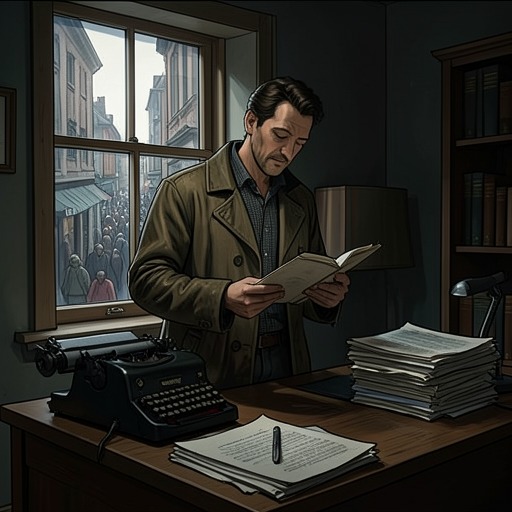
Martin eventually tries to make writing a practical livelihood rather than a dream of immediate masterpieces. After a period of rest and reflection, he tells Ruth he will treat writing as a cold business proposition, believing it can earn more than unskilled work and leave him more time than a regular position. He plans to move to Grub Street and produce jokes, paragraphs, feature articles, humorous and society verse, and material for newspaper syndicates. He does not mistake this commercial strategy for his highest artistic purpose; he sees it as a means of supporting himself while preserving time for more ambitious work.
The plan does not hold. The next day, Martin sets hack-work aside and writes an essay, The Philosophy of Illusion. His movement between commercial calculation and uncompromising creative work captures a persistent tension in his career: he needs income, but resists allowing market demand to define the work he considers valuable. Later, the short pieces he produces to formula do earn money. They help him redeem pledges, pay most of his bills, and buy new bicycle tires, while allowing time for other writing. Yet he hates and derides them, and pins greater hope on the forty dollars he has received from The White Mouse. His most valued stories, essays, and poems continue to be rejected by prestigious magazines even as he sees dull work filling their pages.
His discipline becomes physically punishing. Martin rewrites and polishes earlier work, including The Jostling Street, The Wine of Life, Joy, and the Sea Lyrics, and considers nineteen hours of labor a day insufficient. During periods of hunger, he also endures the craving for tobacco; he stores away the anti-tobacco remedy Ruth bought with her glove money, while she regards giving it up as no more than his duty. He later explains that he has forgotten how to fall asleep peacefully. He switches from a heavy book to a lighter one when drowsy, strikes his head with his knuckles to stay awake, and uses discomfort to force himself to work longer. He says he sleeps four hours and that even five and a half would feel extravagant. His appeal to Ruth is not that she must certify his talent, but that she should love him and have faith in love. He insists that he knows what he has in him, while the exhausted routine behind that insistence shows the cost of trying to make ability undeniable.
Ruth’s response exposes a division between personal affection and literary judgment. She tells Martin she does not think he was made to write, while acknowledging her own literary education. He does not ask her to believe in his writing, but asks her to believe in their love and recalls that she had once told him he must serve an apprenticeship. His faith in his vocation persists even when hers fails. After their relationship reaches a breaking point, Martin returns to his room in a stunned state, sees Overdue on the table, and begins working because it is unfinished. He spends five days on it, seeing no one and eating meagrely. The compulsion to complete the manuscript survives at a moment when he says he does not know what comes next and nothing seems to matter.
Work also carries Martin back into his earlier life with startling force. While alone in his room, he relives the fight with Cheese-Face so completely that he faints as he had on the Eighth Street Bridge years before. He wakes shouting that it took eleven years to beat his opponent, then struggles to orient himself in the present. The manuscripts in the corner, the books he has opened, and the ambitions he has built return to view beside memories of the physical world through which he has passed. The episode makes the past more than background: the bodily history he once treated as evidence of strength can still overwhelm the educated, aspiring self he has made.
Beliefs and Literary Recognition
Martin’s social and political outlook is as combative as his artistic one. In a discussion of power, he rejects both socialism and the form of democracy he regards as disguised pseudo-socialism. He calls himself a complete reactionary and an individualist, condemns merchants and traders as timid rulers absorbed in money-making, and turns toward aristocracy and the ideal of a strong man who can save the state. Invoking Nietzsche, he contrasts what he sees as noble strength with the meek morality of his opponents. His speech is not a moderation of his earlier class ambition but a provocative reversal: rather than asking to be admitted to the existing order, he denounces its assumptions and claims a position outside its political categories.
The recognition Martin receives as an author does not persuade him that readers understand his work. He believes The Shame of the Sun, rather than his other writing, caused the sudden surge in his success. The book began with a first edition of fifteen hundred copies, and even its experienced publishers were astonished by its reception. Martin interprets the result as an unpredictable event, not a reliable judgment of literary value. To him, the bourgeois readers buying his books do not seem capable of comprehending the beauty and power he believes they contain.
That suspicion deepens when he considers the fate of Brissenden’s Ephemera. The public had seized on and torn apart the poem, while now the same public celebrates Martin. He regards Ephemera as incomparably greater than anything he has written, and its reception convinces him that the crowd’s applause and hostility are equally unreliable. Fame, in this view, is not proof that the work has been understood; it is a change in the crowd’s appetite. Martin can become a celebrated author while remaining alienated from the very audience whose approval would ordinarily complete a literary career.
Disillusionment and Ending
The scale of Martin’s acclaim becomes visible in the press clippings and reports of a public furor around his work. The suddenness of the response reminds him of a writer acclaimed by a reading public that, only months later, turned against him. Martin imagines that he too may soon be attacked, and pictures leaving for the South Seas to build a grass house, trade for pearls and copra, cross reefs in an outrigger, catch fish, and hunt wild goats. The imagined journey promises distance from fame and its fickle audience, but the prospect cannot restore his desire to live.
As he recognizes that he is in the Valley of the Shadow, Martin understands that life is fading from him. His relation to sleep has reversed: once he resented it for stealing hours from life, but now he resents life and longs for sleep. He finds its taste bitter and knows that this loss of desire is dangerous. Even the practical thought of packing weighs on him, so he postpones it and goes out to buy automatic rifles, ammunition, and fishing tackle, taking satisfaction in having made a decision without yet doing the burdensome work of leaving. The purchases give shape to a possible escape, but do not resolve the inward crisis that has made life itself feel empty.
In the closing underwater sequence, Martin deliberately drives himself deeper rather than returning to the surface. He watches the luminous trails of fish, pushes his tired limbs onward, and tries to defeat the reflex that makes the body struggle to live. When the effort fails, he experiences pain and suffocation as the last violence of life. His hands and feet beat weakly, but he has gone too deep for them to carry him up. Light flashes in his mind, sound rumbles, and he falls into darkness, where consciousness ends. His death completes the novel’s reversal: the man who believed effort could conquer the distance between his origins and his ambition finally possesses fame, yet cannot find in it a reason to remain alive.